
Latest News
As awareness of neurodiversity continues to grow, sensory tools are becoming recogised as valuable aids for both children and adults. By normalising the use of sensory supports, organisations and communities can create more accessible spaces that encourage focus, wellbeing, and participation for everyone.
Read more here:
Latest News from Sona Sensory – see the latest news about sensory fidget toys in Ireland. Find new information and latest news on the newest and innovative sensory fidget toys for ADHD and Autism regulation for children, schools and CDNT centres. Latest news on sensory tools for regulation.
Latest News: Dublin Airport has two purpose built sensory rooms, designed to help calm passengers who might feel overwhelmed in busy and unfamiliar airport surroundings, located in both Terminal 1 and Terminal 2.
What Is A Sensory Room?
A sensory room is designed to calm passengers who might feel overwhelmed in and around the airport. Depending on the passenger’s needs, users will be able to transform the room from a calming and relaxing environment to a stimulating interactive space full of light, colour and sound.
The Sensory Rooms At Dublin Airport
Our Sensory Rooms include a relaxing bubble wall area, Infinity lights, tactile panels, bean bags, comfortable seating, interactive educational boards to promote dexterity and motor skills, a calming corner and much more.”
More info here:
“For a fidget to become a tool instead of a toy we need to understand how they work and which students they help. Studies that have looked at a variety of movement interventions have found that providing exercise and movement opportunities positively impact learning and behavior.
Movement as small as squeezing a ball to robust physical exercise can increase on task behavior and attention. Movement as an intervention can work with many students but works especially well with those who have significant attention and on task behavior challenges.
Although frequent movement breaks are helpful, it is not always possible for teachers to fit them into the school day. In these situations a fidget becomes a good intervention tool.”
Find out more here:
“We’ve seen them everywhere – fidgets. They’re growing in popularity, among both kids and adults, but what is their true purpose? Why should we use them? They are often referred to as fidget “toys” but they can serve as more than a toy. As occupational therapists, we tend to prefer the word “tools.” Although fidgets may appear fun and enjoyable, they serve a beneficial purpose that can be a great tool in our regulation and attention toolboxes.” – Brown University Health
Read more here:
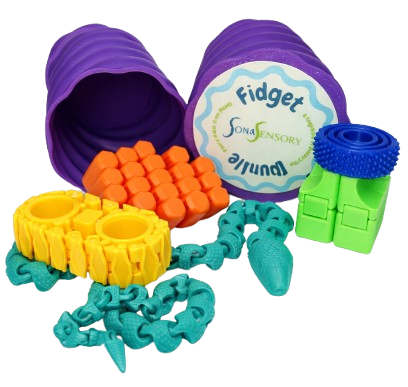
A recent 2025 study on sensory-based stress relief tools found that tactile input, such as fidget devices, can help support nervous system regulation by reducing stress responses and improving focus. The research suggests that structured use of sensory tools may assist individuals in maintaining calmer states and better attention through sensory integration.
Read full study here:
“Sensory regulation is a child’s ability to notice, process, and respond to sensory information in a way that helps them stay calm, focused, and ready to engage. Every day, children take in sounds, movement, touch, light, and body signals. For some children, particularly those with autism, ADHD, or developmental differences, these sensations can feel overwhelming or, at times, not strong enough.”
Read more here:

“Over time, we’re rewarded for being productive, responsible, and in control. Play doesn’t really fit into that,” explains Laura Turley, psychotherapist (MA, MIACP) and founder of Mindology Wellness Centre.
However, simply engaging in it can be hugely beneficial to our overall well-being.
“Play softens the brain,” she notes. “It boosts dopamine, which lifts motivation and enjoyment, while calming the part of the brain that’s scanning for stress or threat. That’s why things feel lighter and easier. The brain becomes more open, more creative, and more connected.”
Read more here:
“An interesting study conducted on lecture attendees found that the more they fidgeted the more information they were able to retain from the lecture. This suggests that the act of fidgeting may in some circumstances have a positive effect on the way an individual processes information and consequently their memory retention. Therefore, allowing employees to use fidget toys may enable them to retain more information than they would be able to if they were forced to stay still. “
Read more here:
Irish Made Awards 2026 – Enter Our Competition!
We Have Been Nominated in the Irish Made Awards 2026!

We are delighted to be finalists in the ‘Kids’ category at the Irish Made Awards 2026!
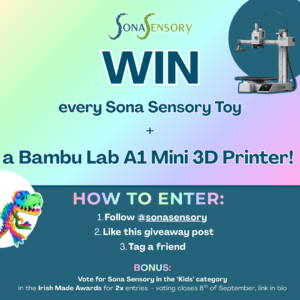
To celebrate our nomination, we are hosting a giveaway competition where you can win every Sona Sensory toy within our range, PLUS a Bambu Lab A1 Mini 3D Printer
Voting for the Irish Made Awards 2026 closed on the 8th of September, and the winner of our competition will be announced on the 15th of September.
Irish Examiner
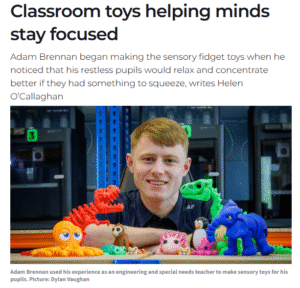
We are incredibly proud to have our journey featured in the Irish Examiner, recognising Sona Sensory as an innovative Irish business making a positive impact through sensory play.
The Irish Examiner feature tells the story of how Sona Sensory was founded by former Special Educational Needs (SEN) teacher Adam Brennan, whose classroom experience inspired him to create sensory toys that genuinely support children while also being proudly designed and manufactured in Ireland.
A Business Inspired by Real Classroom Experience
Before launching Sona Sensory, Adam spent years working with neurodivergent children in schools. Every day, he saw pupils using fidget toys to help them concentrate, self-regulate and stay engaged during lessons.
“I was part of the Nuture programme, which takes a group of four or five students, twice weekly, who find it difficult to be in a big class and to learn – they might have ADHD or ASD. I saw that different fidget toys helped improve their focus, helped them be more regulated in class.“
This firsthand experience highlighted an important gap in the market. While sensory toys were becoming increasingly popular, very few were being manufactured in Ireland. Most products available were imported, leaving little opportunity for locally designed, high-quality alternatives.
Turning an Idea into Reality
What began as a small 3D printing business with just a handful of printers soon evolved into something much bigger.
By combining a background in education with skills in graphics, engineering and 3D printing, Adam developed a range of sensory toys designed to be engaging, durable and practical for everyday use.
As demand grew, so did the business. Today, Sona Sensory operates from its production facility in Kilkenny, where its range of sensory products is manufactured using advanced 3D printing technology.
Proudly Designed and Manufactured in Ireland
Manufacturing locally allows us to maintain high standards of quality while continuing to innovate.
Our products are created using plant-based PLA material and are designed to withstand everyday use in homes, classrooms, therapy settings and sensory spaces.
Being an Irish manufacturer also enables us to respond quickly to customer feedback and continually develop new products that meet the needs of families, educators and healthcare professionals.
Supporting Children Through Play
At Sona Sensory, our mission has always been simple: create sensory products that make a meaningful difference.
Our sensory toys are designed to support:
Focus and concentration
Fine motor skill development
Sensory exploration
Creative, open-ended play
Emotional regulation
Classroom engagement
Whether they’re used at home, in schools or by occupational therapists, our products are designed with real-world needs in mind.
Recognition from the Irish Examiner
Being featured in the Irish Examiner is a proud milestone for Sona Sensory. It recognises not only our growth as an Irish business but also the importance of creating innovative products that support children through play.
We are grateful to our customers, retailers, teachers, therapists and supporters who have helped us grow from a small idea into a trusted Irish sensory toy brand.
We remain committed to designing and manufacturing high-quality sensory toys in Ireland while continuing to develop new products that inspire creativity, encourage learning and make sensory support more accessible.
Thank you to the Irish Examiner for sharing our story, and thank you to everyone who has supported Sona Sensory along the way. We look forward to continuing to innovate and helping even more children, families and educators discover the benefits of sensory play.